

GuideNotesMac
Notes on Mac
The library column, keyboard-first block commands, hover previews, the dossier, and meeting transcripts that file themselves.
The Mac gives Notes a wider desk. The library sits in the sidebar, the page has room to breathe, and almost everything can be done without reaching for the mouse.
The library column
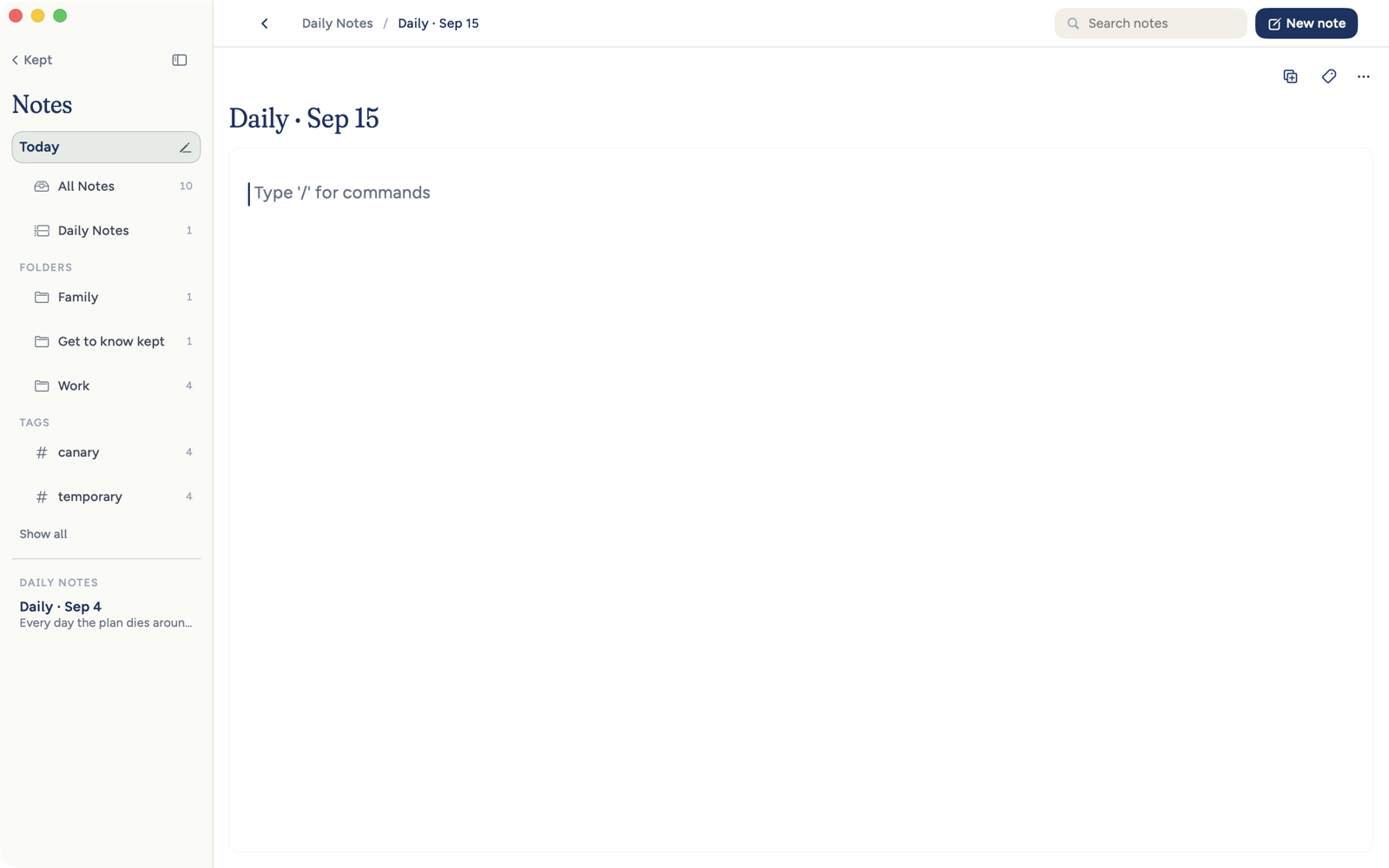
Open Notes and the sidebar becomes the Notes library, headed Notes: Today, Recents once you have them, All Notes, Daily Notes, then your Folders and Tags. All Notes is the default and shows standalone notes plus today's daily note; earlier days wait in Daily Notes.
The library keeps itself in Recent order. Switch it to Manual from its menu to drag folders into the order you want. The Kept row at the top of the column, with its back chevron, returns you to the surface you left, with your selected note remembered.
When the window narrows, the list narrows before the page does. Narrow it further and the list stacks above the editor or opens from the header. A list button beside the path, labeled Library on hover, opens the same library as a popover when the sidebar is hidden.
Toolbar
One row carries Notes' navigation: Back, the path to the current note, Search notes, and New note. ⇧⌘N starts a note in the folder you are looking at, or an unfiled one from All Notes, Daily Notes, or a tag. ⌘[ goes back. ⇧⌘F puts the caret in search; esc clears it, then leaves it.
Keyboard in the editor
/opens the block palette. Hold ⌘ while it is open and the first nine rows show a number; ⌘1 through ⌘9 insert without typing a name.- Abbreviations filter the palette:
h1h2h3for headings,tdfor a to-do,nlandblfor numbered and bulleted lists, plusulolhrbqsepif that is what your fingers know. - ⌘B, ⌘I, ⇧⌘H, ⇧⌘E for bold, italic, highlight, and code on a selection.
- ⌘F finds inside the open note; ⇧⌘F searches every note by words; ⇧⌘K searches every note by meaning, when Cloud AI is on.
- ⌃⌥I opens Insert and format beside the note, or as a popover when the column is narrow; arrow keys walk it and a preview of each command appears as you go.
- esc closes whatever is on top first: a mention or block palette, the formatting bar, Find, and so on down to the inspector.
- Find offers next, previous, replace, and replace all.
Hover previews
A linked to-do wears a faint mint tint. Rest the pointer on it and a small preview of the task appears beside the words; ⌘-click the checkbox opens the same preview. Open task in the preview opens the full inspector.
Linking a task to a note
From a task's inspector, Link note opens a two-pane picker. Select a note on the left and its words appear on the right as plain text, so you can confirm it is the right one before you link it. A note whose full text has not reached this Mac loads it; a note made of pictures says what it holds rather than showing a blank pane.
Meeting transcripts
Kept can watch a folder on your Mac and file new transcripts as notes. Turn it on in Settings → Meeting import and choose the folder to watch. Each new .txt, .md, .vtt, or .srt file that lands there after you start watching, and that holds readable text, becomes an ordinary note in your account, unfiled, ready to search and to file where you like. A transcript is treated as text, never as instructions: Kept will not act on anything written inside one. If Notes is turned off, import pauses and says so.
Sharing and images
Share… in a note's menu previews what the page will carry before the first link, then creates a view, comment, or edit link, with a Let search engines find this switch that starts off. Each permission's title and explanation form one click target. Export writes the note as Markdown, plain text, or PDF. Link task attaches an existing task to the note. Images offer S, M, and L sizes and an alt text field; Undo restores the previous choice.
Next: Habits.